


.jpg)

Solar Panel Cleaning Is Not About “Increasing” Power Output —It’s About Restoring It
- INTEGRA GLOBAL

- Feb 7
- 3 min read
One of the most frequently asked questions about solar panel cleaning is:“How much does power generation increase after cleaning?”
It’s a question that expects a quantitative answer, but it also contains a subtle misunderstanding.
A more accurate way to put it is this:Solar panel cleaning does not increase power output — it restores power output that has been lost due to contamination.
Power Output Is Not Designed to Decline
The power output of a solar power plant is calculated at the time of installation, based on solar irradiance, tilt angle, module efficiency, and other design parameters.In other words, the system is designed to maintain a certain level of performance under normal conditions.
However, over time, various contaminants accumulate on the panel surface — fine dust, sand, pollen, air pollution, bird droppings, and more.These contaminants do not damage the panels, but they block sunlight from reaching the cells.As a result, power output gradually declines.
The key issue is that this decline happens slowly and almost invisibly.
Power Loss Does Not Appear as a “Problem”
Power loss caused by contamination does not occur suddenly.
2% today
5% after a month
10% or more before it is noticed
Because this loss progresses gradually and varies by region, season, and surrounding environment, operators often perceive it as a normal fluctuation rather than a problem.
Yet this loss is not due to equipment aging or unavoidable degradation.It is a loss that can be fully recovered through proper maintenance.
This is why power output appears to “increase” after cleaning.In reality, the system is not performing better than before — it is simply returning to its original condition.
It is similar to how a car regains its original performance after an engine oil and filter change.
Solar Panel Cleaning Is Maintenance, Not an Optional Extra
When solar panel cleaning is viewed only as an additional expense, decisions tend to be postponed.But when viewed from a maintenance perspective, the situation changes.
Panel cleaning is:
a basic requirement for maintaining system performance, and
neglecting it means allowing avoidable power losses to continue.
For medium- and large-scale solar plants, or facilities where annual energy yield is critical, cleaning is not optional.It is part of operational quality management.
Stopping invisible losses and allowing the system to perform as designed —this is the true purpose of solar panel cleaning.
The important question is not “How much did output increase?”but “Is our plant maintaining its designed performance?”
Why Power Loss Often Goes Unnoticed
Many operators sense that power generation is not what it used to be, yet still think:“There’s probably no major issue,” or“Rain will take care of it.”
This is not due to lack of attention, but because power loss does not present itself as an obvious abnormal signal.
Power generation is heavily influenced by weather, cloud cover, temperature, and seasonal changes.Even when contamination is the real cause, it is easy to attribute lower output to poor weather conditions.
Over time, reference points such as:
initial design output, and
early performance data
become unclear.Eventually, the reduced output becomes the new “normal.”
Because contamination is not a failure or malfunction, it rarely triggers alarms in monitoring systems.The system appears normal — but it is no longer operating at its optimal state.
This is how power losses quietly, steadily, and continuously accumulate.
Cleaning Frequency Is Not About “How Many Times a Year”
“How often should panels be cleaned?”There is no universal answer.
Cleaning frequency depends on installation conditions, surrounding environment, panel angle, and the type of contamination.Even within the same region, contamination rates vary significantly between agricultural areas, urban zones, coastal sites, industrial complexes, and pollen-heavy regions.
The key factor is not how many times cleaning is performed,but when performance begins to decline.
For example:
If noticeable output loss occurs every 2–3 months, a shorter cleaning cycle is appropriate.
If performance remains stable for over six months, the cycle can be extended.
By observing performance trends over time and comparing pre- and post-cleaning data, each site can establish an optimized, site-specific cleaning schedule.
Regular Cleaning Is Preventive Maintenance
Solar panel cleaning is not a reactive measure taken after problems arise.It is preventive maintenance that restores the system to its intended condition.
Losses do not occur all at once — they accumulate gradually.They may be difficult to notice in the short term, but over time, they become significant.
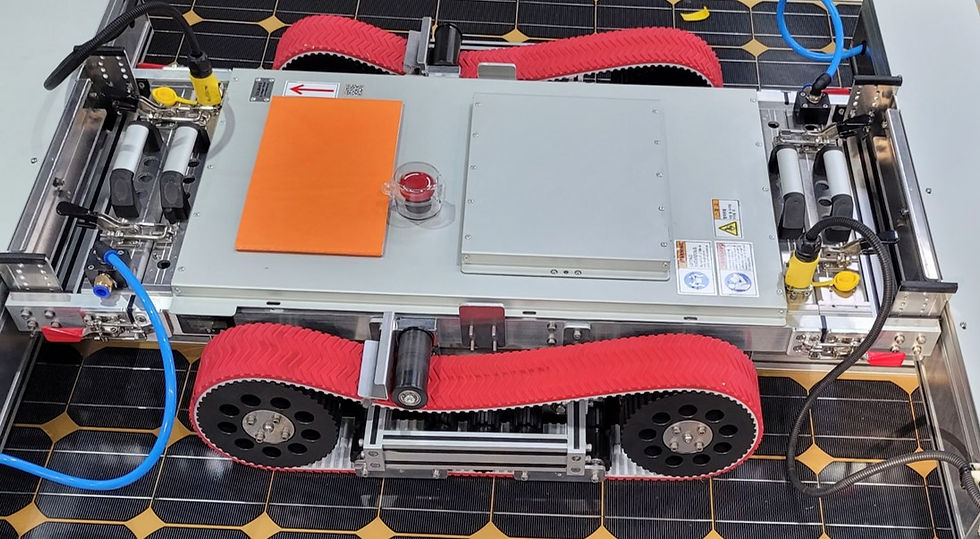


Solmaks F Series Solar Panel Cleaning Systemhttps://www.integrag.com/ko/solmaks-f
Tel. : +82 31 889 5551

Comments